

TREND #1: Women Get Their Own Lane in Longevity
Men have dominated the longevity market, but the future is female
By Beth McGroarty
Overview
The booming longevity market—like medicine before it—is tacitly male: women’s path to health is extrapolated from men’s data and protocols designed for men. That era is ending. Research mounts that women age fundamentally differently, with the ovary functioning as “command central” for women’s health, and its decline (aka menopause) dramatically accelerating systemic aging in women. This leads to a cascade of conditions women suffer far more and longer: from immune disorders to dementia to osteoporosis. Men suffer no such “gonadal death” and stark “before” and “after” health decline.
Slowing/stopping ovarian decline will be the next big biotech breakthrough, and women scientists are busy working on it, from ovarian stem cell therapies to tackling ovarian fibrosis. And with the new framework that “ovary-span” is the lynchpin to women’s healthspan, the wellness market will now move beyond narrowly managing menopause symptoms to tackling ovarian aging and its specific health fallouts. This requires a new longevity paradigm: interventions tailored to women across every decade (from their 20s to 90s). It means testing and interventions for conditions that hit women hardest (from cardiovascular disease to dementia to osteoporosis); ovarian aging tests becoming the new vital sign, hormone replacement therapy boomeranging back as longevity medicine, a focus on lifestyle interventions that best preserve ovarian reserve, and strength training reframed as a non-negotiable for women’s longevity.
The trend details how basically every wellness market is now pivoting from treating menopause to more serious whole-life, medical-wellness longevity programs for women: wellness resorts, longevity clinics, big telehealth and women’s health platforms, gyms, diagnostics and wearables. And as women finally shape longevity, its “bro” culture will change, too: less ultrahuman optimization; more human approaches.
Purchase Report | View All 10 Trends | GWS Writers Page
Women Get Their Own Lane in Longevity: Key Questions & Answers
1. What does “Women Get Their Own Lane in Longevity” mean?
It means longevity is finally being built around women’s biology and biological clocks instead of borrowing men’s data and protocols. The next chapter is less “biohacking bros” and more women-specific healthspan: ovarian, heart, brain, bone, immune, metabolic, and mental health across every life stage.
2. Why has longevity been so male-coded until now?
There has been shocking, decades-long gender inequities in medical research, and those inequities have continued in the modern longevity movement, where research on aging focuses on men’s bodies and biology. Even as late as 2015, women still accounted for less than 35% of participants in early-stage trials––including trials on aging and longevity. Only 2% of venture capital in health goes towards women–and 90% of that is narrowly focused on reproduction and fertility, as medicine has long viewed women as “walking wombs.”
3. If women live longer, why is women’s longevity such a big issue?
Women live longer (in every country, across all socioeconomic groups, and by 5-6 years on average) but spend far more time than men (25% more years) in poor health. The goal of new women’s longevity programs is to shrink the “sick-span” and expand healthspan: more years with strength, clarity, mobility, and independence.
4. How do women age differently than men?
Men live until 90 with a fully functioning gonad, women do not. And as ovarian function declines/dies, systemic aging is supercharged for women. Men experience no such stark “before” and “after” health decline. Women are exponentially more likely to suffer autoimmune diseases, dementia, thyroid conditions and osteoporosis than men––and cardiovascular disease (women’s #1 killer) and diabetes radically accelerate with ovarian decline. The health costs of the loss of the ovary at menopause for women is unique and staggering.
5. Why are the ovaries being called “command central” for women’s aging?
Research around the ovary has been stuck in fertility. But studies mount that the ovaries are endocrine organs that function as the complex signaling network that regulates women’s organs and systems. They are being newly understood as the key, if woefully underestimated regulator of women’s aging and longevity.
6. Is menopause “the problem,” or is it ovarian aging?
The trend is reframing the conversation from a narrow focus on only managing menopause symptoms to understanding and intervening in ovarian aging across decades. Menopause is the “event” people recognize; ovarian aging is the much longer process underneath it.
7. What conditions are most tied to the post-ovarian-decline years?
Women see increased prevalence of issues like cardiovascular disease, osteoporosis, metabolic dysfunction/diabetes, autoimmune disease, thyroid disorders, and dementia. The core point: the ripple effects aren’t “just hot flashes.”
8. What’s changing in 2026 specifically?
The health, wellness and longevity market is moving from midlife-only menopause care (and “soft” wellness-light approaches) toward much more serious, medical-wellness, whole-life women’s longevity care: earlier and different testing, earlier strength and metabolic foundations, and more women-specific diagnostics, coaching, and clinical longevity programs.
9. What’s the shift in hormone replacement therapy (HRT) right now?
HRT is being reframed from menopause “symptom relief” to potential longevity medicine, for its significant heart, brain and bone health benefits. This depends on timing, formulation, and individual risk. The key is thoughtful, personalized care, not one-size-fits-all hormones-for-everyone marketing.
10. What new diagnostics are becoming central in women’s longevity?
One big idea: given that ovarian health and “ovary-span” plays such a huge role in women’s health and healthspan, women will start tracking ovarian health the way they track cholesterol or blood pressure. AMH (anti-Müllerian hormone) is a strong, consistent marker of ovarian reserve, alongside Antral Follicular Count (AFC), and even ultrasounds that show how many visible ovarian follicles remain. New “ovarian age” diagnostics are now being worked on, and the future is every woman having a way to understand her own ovarian state, timeline and trajectory.
11. What’s the most practical, evidence-friendly “longevity lever” for women right now?
Women scientists are busy working on cutting-edge interventions that could slow––even stop––ovarian decline. Until such a breakthrough, one non-negotiable intervention is strength training, as building muscle and bone is proven to be especially crucial to women’s longevity––key to long-term independence, metabolic health and fall prevention.
12. How will the culture of longevity change as women shape it?
Expect less obsession with extreme, competitive optimization and more focus on sustainable, integrative and human approaches to healthspan: community and connection, emotional and mental wellness, stress-reduction––and joy and meaning. These pillars of wellness have quickly taken a back seat in too many longevity programs, despite the mountains of evidence that they, more than any high-tech hack, improve both healthspan and longevity. Less leaderboard, more lived-in wellbeing.
Other Resources Related to Women’s Longevity

Functional Medicine is Longevity: Dr. Robin Berzin on Biomarkers, AI and the Future of Healthspan
The Wellness Roundtable Podcast
By the Global Wellness Institute

Why Women’s Health is Central to Longevity with Dr. Piraye Beim
The Wellness Roundtable Podcast
By the Global Wellness Institute

A Conversation on Women & Longevity
2026 New York Media Event
Robin Berzin MD, CEO of Parsley Health & Alexia Brue, Founder, The Practice: Habits for Healthspan
Meet the Author

Beth McGroarty
LinkedIn | GWS writer page
VP, Research & Forecasting, Global Wellness Summit, United States
Beth McGroarty is vice president of Research and Forecasting for the Global Wellness Institute (GWI) and the Global Wellness Summit (GWS). She has directed the GWS’s annual Wellness Trends Report for over a decade and authors The Trendium, a monthly analysis of emerging developments across the global wellness market. Beth also serves as editor of the GWI’s research-focused Global Wellness Brief and oversees WellnessEvidence.com, the first online resource dedicated to the medical evidence supporting dozens of wellness approaches. She is frequently quoted in major global media outlets on wellness industry insights and trends.
Watch Author Video
From the 2026 New York Media Event
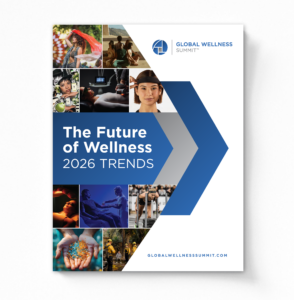
Discover the top 10 trends shaping the future of the global wellness economy.
Backed by more than a decade of trusted forecasting from the Global Wellness Summit, this annual report goes beyond trend spotting to deliver expert analysis, real-world implications, and strategic insight for leaders, innovators, and investors. Used worldwide to anticipate what’s next in wellness, this is the definitive guide to the forces that will shape the industry in 2026 and beyond.

- Women Get Their Own Lane in Longevity
- The Over-Optimization Backlash
- The Rise of Neurowellness
- Fragrance Layering
- Ready Is the New Well
- Skin Longevity Redefines Beauty
- The Festivalization of Wellness
- Women & Sports: The Revolution Continues
- Tackling Microplastics as a Human Health Issue
- Longevity Residences